Guide
The AI Authority Score: one number for your standing in the AI answer layer
Moz built a category on Domain Authority. The idea was sound: one number for how much the web trusts you. The AI Authority Score is that same idea, moved to where customers now ask their questions.
For twenty years, marketers leaned on a single trust number. Moz called it Domain Authority. Semrush calls it Authority Score. The appeal is obvious: instead of staring at fifty metrics, you get one figure that says, roughly, how much standing you have. But all of those scores grade the same thing, your standing on the open web of links and pages. None of them say a word about whether an AI engine names you when a customer asks for a recommendation. That blind spot is the reason the AI Authority Score exists.
What goes into it
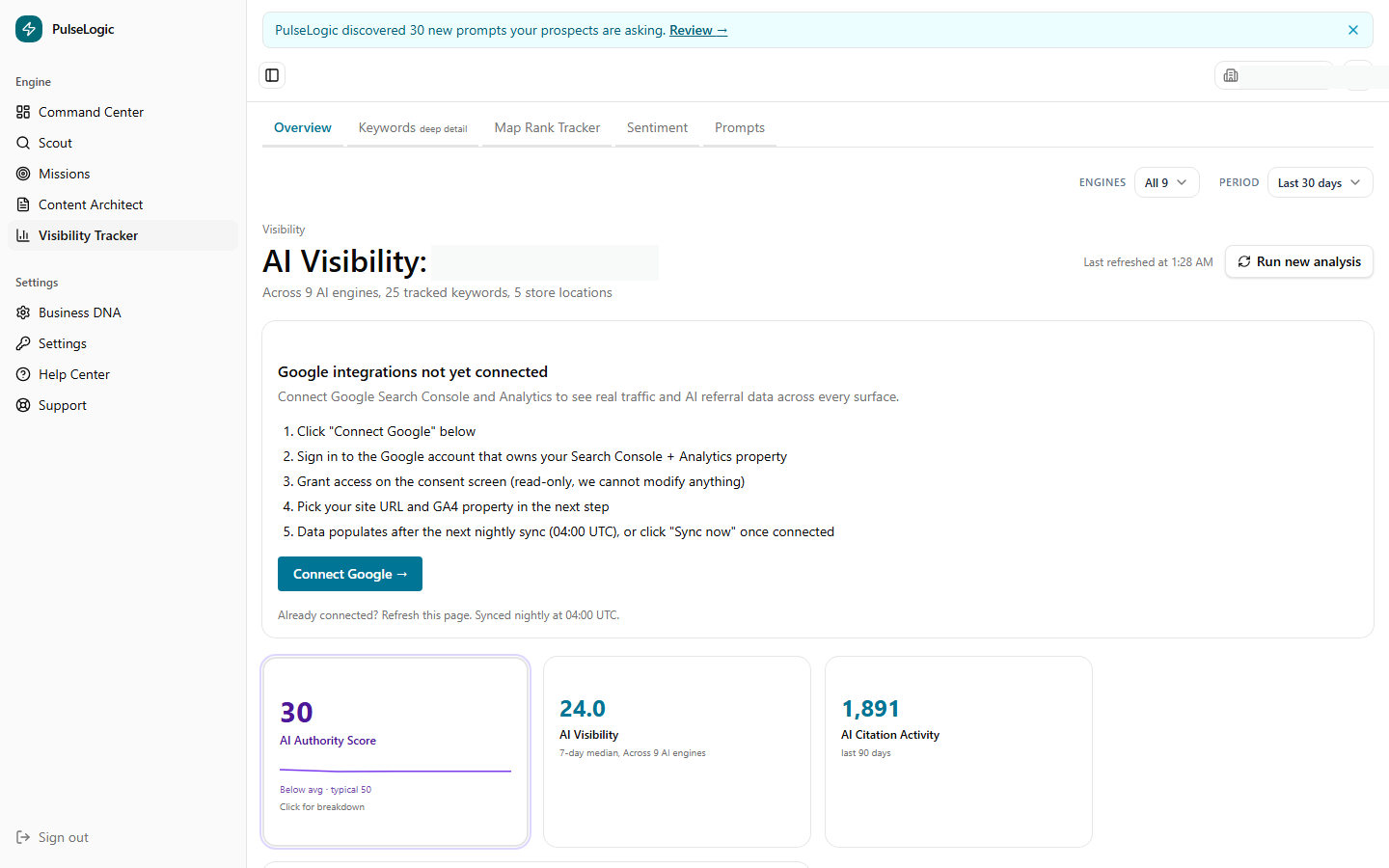
The AI Authority Score is a composite. It blends four things, weighted by how much each one tells you about your real standing in AI answers.
| Component | What it measures | Weight |
|---|---|---|
| AI Visibility | How often and how prominently AI engines cite you | 40% |
| AI Citation Activity | The breadth and recency of your citations across surfaces | 30% |
| Measured AI Referrals | Traffic that actually arrives from AI sources | 20% |
| Mission Velocity | How consistently you are publishing new answers | 10% |
The first two, worth seventy percent together, measure whether the AI ecosystem trusts and quotes you. The third grounds the score in real outcomes, not just appearances. The fourth rewards momentum. Authority in this layer is not static; it accrues to businesses that keep answering new questions, and publishing velocity is the leading indicator of that. So it earns a place even at a modest weight.
Why it survives the death of easy web tracking
This score is built to outlast the tracking that older ones rely on. Traditional analytics get less reliable every year: cookie blockers, privacy defaults, and native AI apps that answer without sending a click all eat away at the web tracking that scores like Domain Authority quietly depend on. The AI Authority Score sidesteps that decay. Most of it comes from PulseLogic sampling AI answers directly to see whether you are cited, not from web analytics in decline. It reads the AI layer at the source. As the old tracking erodes, a score built on direct sampling holds up where one built on referral logs falls apart.
The metrics that depend on counting clicks are quietly breaking. A score that reads the AI answers directly is the one that still works next year.
How to read your score
Like the underlying visibility measure, the AI Authority Score is benchmarked by business type, so you are compared to businesses like yours rather than to a national giant. In our five-store regional-grocer demonstration account, the score comes back benchmarked for local retail, measured against businesses like it rather than a national giant. That is the useful framing: not a raw number in a vacuum, but a number with a verdict attached, above or below the bar for someone in your position. And because the components are visible, a low score is also a diagnosis. Weak on visibility? Publish answers to the queries you are losing. Thin on citation breadth? Cover more of the questions your customers ask. Low velocity? You have simply stopped shipping, and the fix is to start again.
One number, pointed at the right layer
The value of a single authority number was never the number itself. It was that one figure could tell a busy owner whether things were trending the right way without reading a manual. The AI Authority Score keeps that virtue and aims it at the layer that increasingly decides who gets the customer. It is the same trusted idea your SEO tools gave you, finally pointed at AI search.
Book a walkthrough and we will compute it on your real business and show you which component to fix first.
Get my scoreScoring mechanics reflect PulseLogic as of June 2026. The figures come from a demonstration account used to show how the score behaves.