Guide
AI share of voice: how you compare to competitors in AI answers
Your standing in AI search is not measured in a vacuum. Every answer is a competition, and the only score that matters is how you stack up against the business named right next to you.
You can have a respectable AI visibility score and still be losing, because visibility is relative. When a shopper asks an AI engine for the best option in your category, the engine does not just decide whether to mention you. It decides whether to mention you instead of, or ahead of, a competitor. If your rival is named first and described more warmly, your decent score did not win the customer. Share of voice captures this. The question stops being "am I visible" and becomes "how much of the conversation do I own against the businesses I actually compete with."
The comparison customers actually make
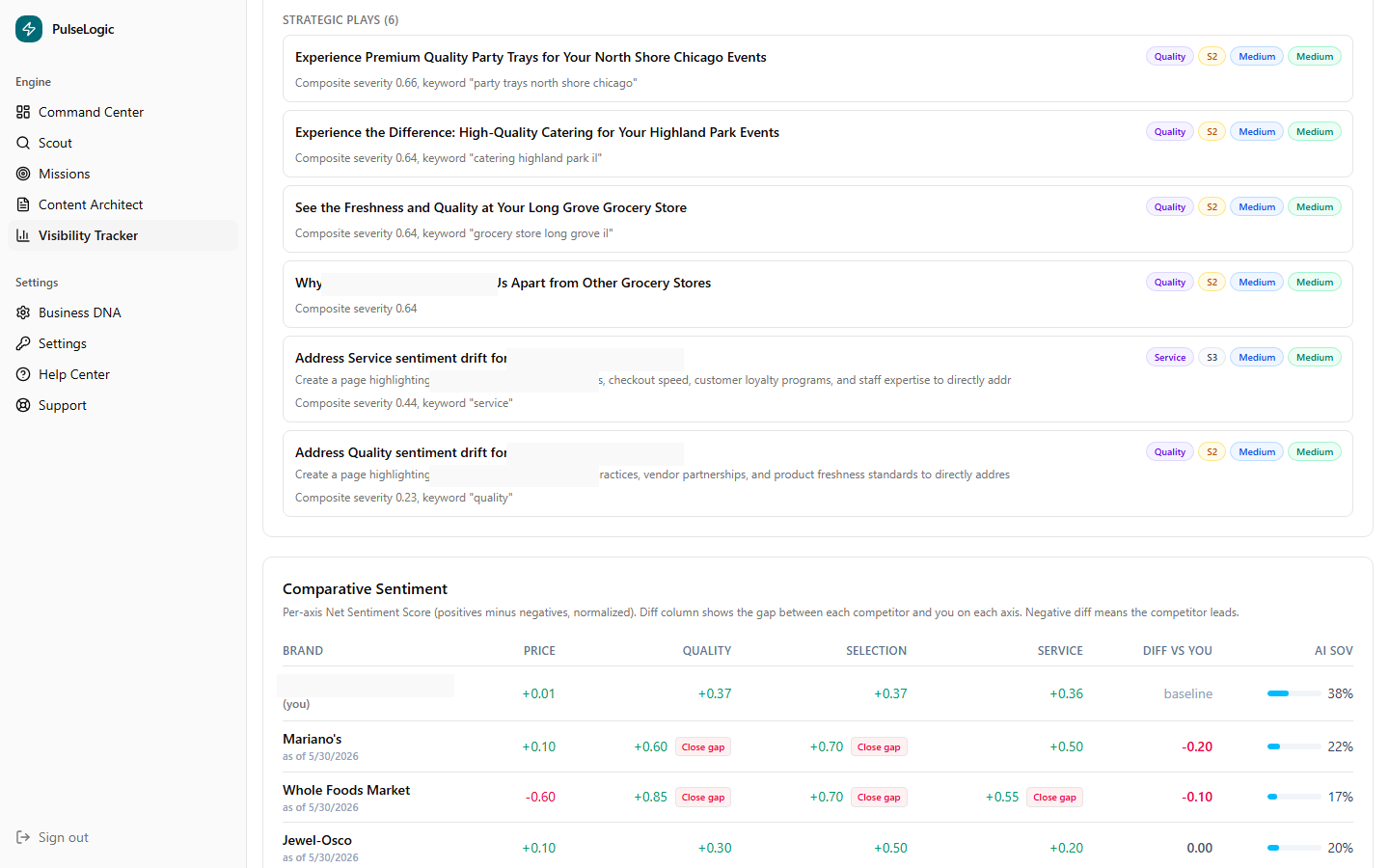
People do not choose a grocer on one factor. They weigh price against quality, selection against service, and AI engines have absorbed that same multi-dimensional reasoning from the web. A single "who is better" number would flatten the very thing that decides the sale. So PulseLogic's comparative view scores you and each competitor on the dimensions that matter in your category, and shows the gap on every one.
| Dimension | You | Competitor | Difference |
|---|---|---|---|
| Price | good | stronger | behind |
| Quality | strong | good | ahead |
| Selection | good | strong | behind |
| Service | strong | average | ahead |
Illustrative layout. The real grid scores each axis from live AI sampling and updates as the answers change.
Read that grid and your strategy writes itself. You are ahead on quality and service, behind on price and selection. So you do not fight a price war you would lose. You publish content that reframes the decision around quality and service, the ground where the AI engines already favor you, and you address the selection objection directly where it is costing you. The grid does not just keep score. It tells you which battle to pick.
Difference is the number to watch
The most useful column is not your score or the competitor's. It is the gap between them. A negative gap is a precise diagnosis: this is where an engine prefers a rival, on this dimension, for these questions. A positive gap is an asset to press. Track the difference over time and it tells you something more, whether your content is closing a gap or a competitor is pulling away. That is the kind of competitive intelligence that used to need a research budget and now sits on one screen.
Stop asking whether you are visible. Start asking where, and against whom, you are losing the comparison. That is the question with an action attached.
The worked example
Our demonstration grocer competes with national and regional brands depending on the town. The comparative grid might show the local business ahead on service and the freshness of its counters, behind on raw selection against a larger chain, and roughly even on price. In the demonstration account, the share-of-voice column shows a lead to defend, not a deficit to close. That is not a defeat; it is a map. It says to lean into the service-and-freshness story, where a real fish manager and a real prepared-foods team are genuine advantages, and to answer the selection question rather than pretend it is not being asked. The grid turns a vague sense of "the big chains are tough competition" into a short list of specific, winnable moves.
Closing the gap
When the grid shows a gap worth closing, PulseLogic does not leave you to figure out the next step. The comparison feeds straight into the content engine: the dimension where you are losing becomes the brief for a piece that argues your case on that exact ground, in your voice, ready to publish. See the gap, write the answer, watch the difference move.
Book a walkthrough and we will run the head-to-head against your real competitors and show you which gaps to close first.
Compare me to competitorsCapabilities reflect PulseLogic as of June 2026. This example uses a demonstration account.