Guide
The AIV score: how to measure whether AI engines actually cite your business
"Are we showing up in AI search" is a yes-or-no question with a useless answer. AIV turns it into a number that moves when you do the work.
Tracking AI visibility by hand fails for a simple reason. You ask ChatGPT a question, you show up, you feel good. You ask a slightly different question the next day, you do not show up, you feel bad. Neither moment tells you anything, because a single check is noise. What you need is a measure that samples many questions across many engines, weighs how well you did on each, and returns one number you can watch over time. That is the AIV score: PulseLogic's AI Visibility score, from 0 to 100.
It is not just "did you appear"
AIV scores the quality of your citation, not just its existence. That is the heart of it. Showing up in an AI answer is not binary: there is a real difference between being the source an engine builds its answer around and being a name dropped in passing at the bottom. AIV reflects that difference, scoring each appearance by how prominent it was.
| How you appeared | What it means | Relative weight |
|---|---|---|
| Your content rendered as the answer | The engine built the response from you | Highest |
| Cited in the top position | You are the lead source | High |
| Cited among the first few sources | You are in the core set | Moderate |
| Cited further down | You made the list, barely | Lower |
| Mentioned without a citation | Named, but not sourced | Partial |
| Absent | You were not in the answer | Zero |
This matters because two businesses can both "show up" and be in completely different shape. One is the source the engine quotes; the other is an afterthought a competitor outranks every time. A binary checkmark hides that. AIV does not.
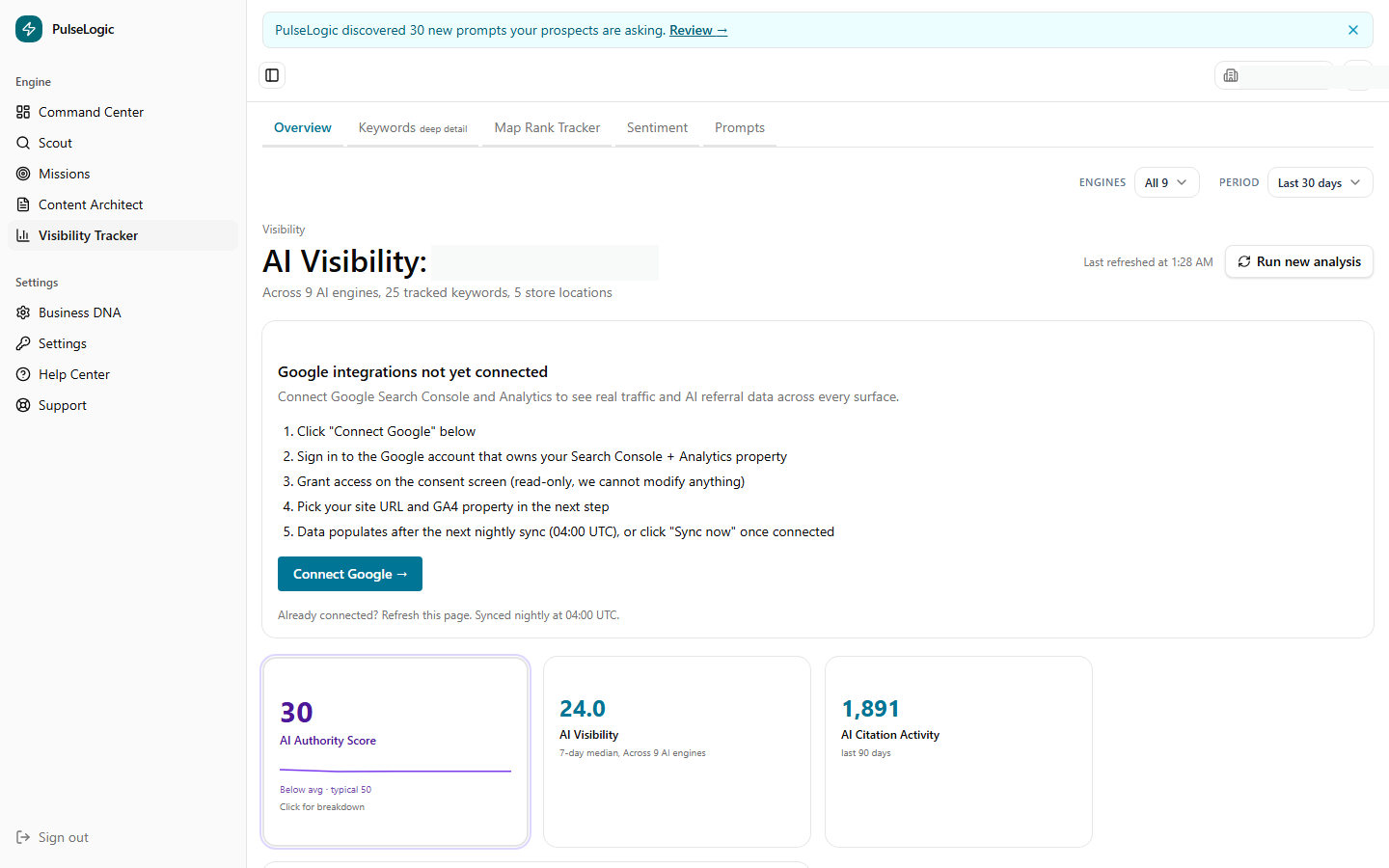
It is benchmarked, so the number means something
A bare number means nothing until you know the bar. A score of 30 sounds low, but whether it is strong or weak depends entirely on your type of business. AIV is benchmarked by business archetype, so a local retailer is compared to other local retailers, a local service business to other local service businesses, and so on. A national chain with a thousand-page site lives in a different weight class, and comparing yourself to it would only discourage you. The platform tells you plainly whether your score is below, around, or above average for your category. That is the difference between a vanity number and a number you can take to a team meeting and act on.
A score you cannot benchmark is a thermometer with no marks on it. AIV tells you not just your temperature, but whether it is normal for someone like you.
It is smoothed, so you watch the signal not the noise
AI answers wobble day to day. AIV reports on a rolling basis instead of reacting to a single day's sample, which keeps you from chasing every twitch. You see the trend, the thing that actually reflects whether your content work is paying off, rather than a jittery line that spikes and dips for no reason you can act on. Publish a strong answer to a question you were losing, and you want the score to respond over the following weeks. A smoothed measure lets you see exactly that.
The point of the number is what you do with it
A score on its own is just feedback. AIV earns its keep because PulseLogic acts on it. When the score reveals a query where you are absent and competitors are cited, the platform turns that gap into a writing mission, drafts the answer in your voice, and publishes it. Then the score tells you whether it worked. The number is the start of a loop, not the end of a report.
Book a walkthrough and we will calculate your AI Visibility score on your real business and show you what is dragging it down.
Get my AIV scoreScoring mechanics reflect PulseLogic as of June 2026. Benchmarks use business-type archetypes and update as the dataset grows.