Guide
Per-city AI visibility: track every location in the Map Pack and in AI answers
If you run more than one location, you do not have an AI visibility problem. You have several, and they do not look alike.
An owner with five stores asks a reasonable question: "Are we showing up in AI search?" The honest answer is another question: "In which town?" The business that is the obvious recommendation in one market can be a complete unknown fifteen miles away. AI engines and the local map both answer place-based questions with place-specific logic. A single company-wide visibility number averages those markets together and tells you almost nothing you can use.
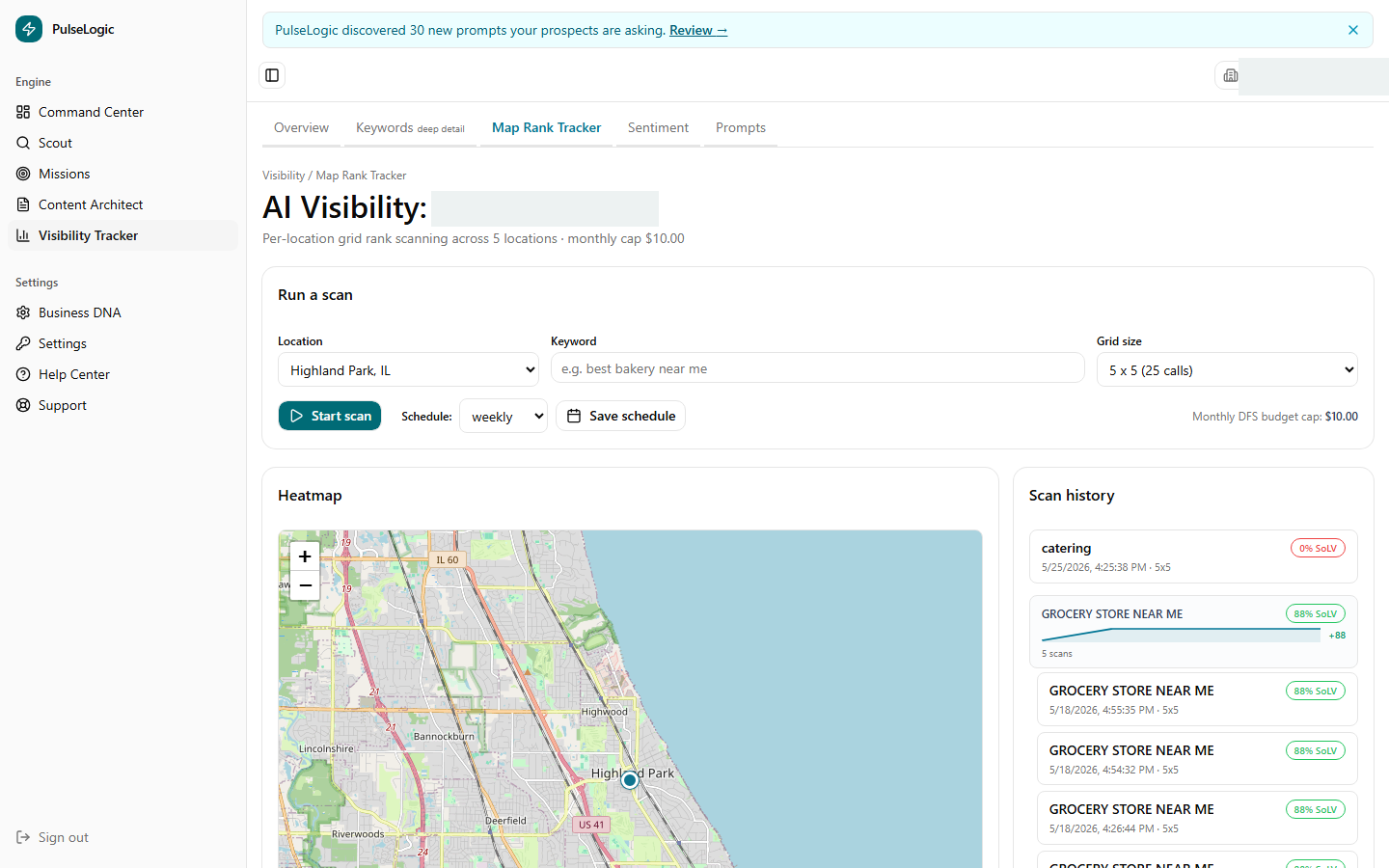
PulseLogic tracks visibility per location for exactly this reason. Each city gets its own read, in the AI answers and in the local map pack, so you can see where you are winning, where you are losing, and where to spend your next hour of effort.
Why one average lies to you
Say your five stores score, in AI visibility terms, as strong, strong, average, weak, and invisible. Averaged, that reads as "okay, room to improve," so you shrug and move on. Broken out, it reads as "one market is bleeding and another never started," so you act today. The average is not just less precise. It actively hides the two markets that need you most while the two that are already fine flatter the result. For a multi-location business, the company-wide number is the least useful one you can look at.
The market that is dragging you down is invisible in the average. That is the whole reason to look city by city.
What "per-city" actually covers
Two layers, tracked for each location:
- The local map pack. The map-and-three-businesses block that appears for "near me" and named-town searches. This is the classic local battleground, and PulseLogic tracks your standing in it per city.
- The AI answers. Whether the AI engines name your specific location when someone in that town asks a question you should own. A win in one town's answer does not carry to the next, so each is read on its own.
Together they tell you not just whether you are visible, but where, which is the only version of the question a multi-location owner can do anything with.
From a weak market to a fix
Seeing the weak market is half the value. The other half is what you do about it, and per-city tracking makes the fix specific. If Libertyville is weak on "organic produce near me," the answer is not a generic corporate blog post. It is a Libertyville-specific answer to that Libertyville question, the kind of locally grounded content AI engines and the map both reward. PulseLogic turns the weak market into a targeted writing mission, drafts the local answer in your voice, and publishes it. Then the per-city score tells you whether that market moved. You are no longer treating five stores as one blurry brand. You are running five focused local campaigns from one screen.
The worked example
Our demonstration grocer runs five North Shore stores: Highland Park, Northbrook, Lake Forest, Libertyville, and Long Grove. Each sits in a different competitive mix, facing some combination of national and regional competitors depending on the town. Treating those as one market would be a mistake. The Highland Park store might already win "best seafood counter nearby" while the Long Grove store is invisible for the same query in its own town. Per-city tracking surfaces that gap, and the fix is a Long Grove answer, not a press release for the whole chain.
Book a walkthrough and we will map your AI visibility and local standing for each of your locations.
Map my locationsCapabilities reflect PulseLogic as of June 2026. This example uses a demonstration account.