Guide
What is generative engine optimization (GEO), and why local businesses can't ignore it
SEO got you into the list of links. GEO gets you into the answer. For a growing share of searches, the answer is all the customer reads.
Generative engine optimization, GEO for short, is the practice of optimizing your content so AI answer engines name and cite your business when they generate a response. That is the whole idea in one sentence. It has earned its own name because AI engines do not work like the search you grew up with. They do not hand the searcher a page of links and let them choose. They read the web, synthesize an answer, and name a few sources. GEO is the work of being one of the named sources.
If that sounds like SEO with a new label, stay with me. The difference is real, and it changes what you publish.
SEO and GEO, side by side
| SEO | GEO | |
|---|---|---|
| Goal | Rank high in a list of links | Be named inside a synthesized answer |
| What the user sees | Ten blue links, picks one | One answer, naming two or three sources |
| What wins | Authority, keywords, links, page speed | Clear answers, trustworthy specifics, clean structure and markup |
| How you measure it | Position, clicks, impressions | Whether you are cited, where, and how prominently |
The two are not enemies. Good SEO foundations help GEO, because the same clarity and structure that help a page rank also help an AI engine quote it. But you can rank well on Google and still be completely absent from AI answers. The engine is asking a different question. Not "which page is most authoritative," but "which source gives me the cleanest, most trustworthy piece of this answer." That is why GEO needs its own attention.
Why local businesses feel this first
Local search is where AI answers get concrete. When someone asks "best place for fresh fish on the North Shore" or "grocery store near Northbrook with good prepared foods," the AI engine has to name specific businesses. There is no hiding in a long list. You are either in the answer or you are not. For a local business that has published almost nothing structured, that is a threat. For one that publishes clear, sourced answers to the questions its town is asking, it is a rare opening, because most competitors have not figured this out yet.
The businesses winning GEO right now are not the biggest. They are the ones that answered the question clearly before anyone else bothered to.
What GEO actually requires
GEO is less mysterious than it sounds. It comes down to four habits.
- Answer real questions directly. Lead with the answer, then explain. AI engines lift clean, self-contained answers.
- Be specific and true. Named experts, real details, local facts. Generic filler does not get cited; concrete answers do.
- Structure it cleanly. Clear headings, short lead paragraphs, logical order. The engine has to be able to extract your answer.
- Mark it up. Validated structured data tells the engine what your content is, which helps it quote you accurately.
None of that is exotic. It is good writing plus clean technical hygiene. The hard part for most businesses is not knowing how. It is doing it consistently across every question that matters, and knowing whether it worked.
How PulseLogic runs the GEO loop for you
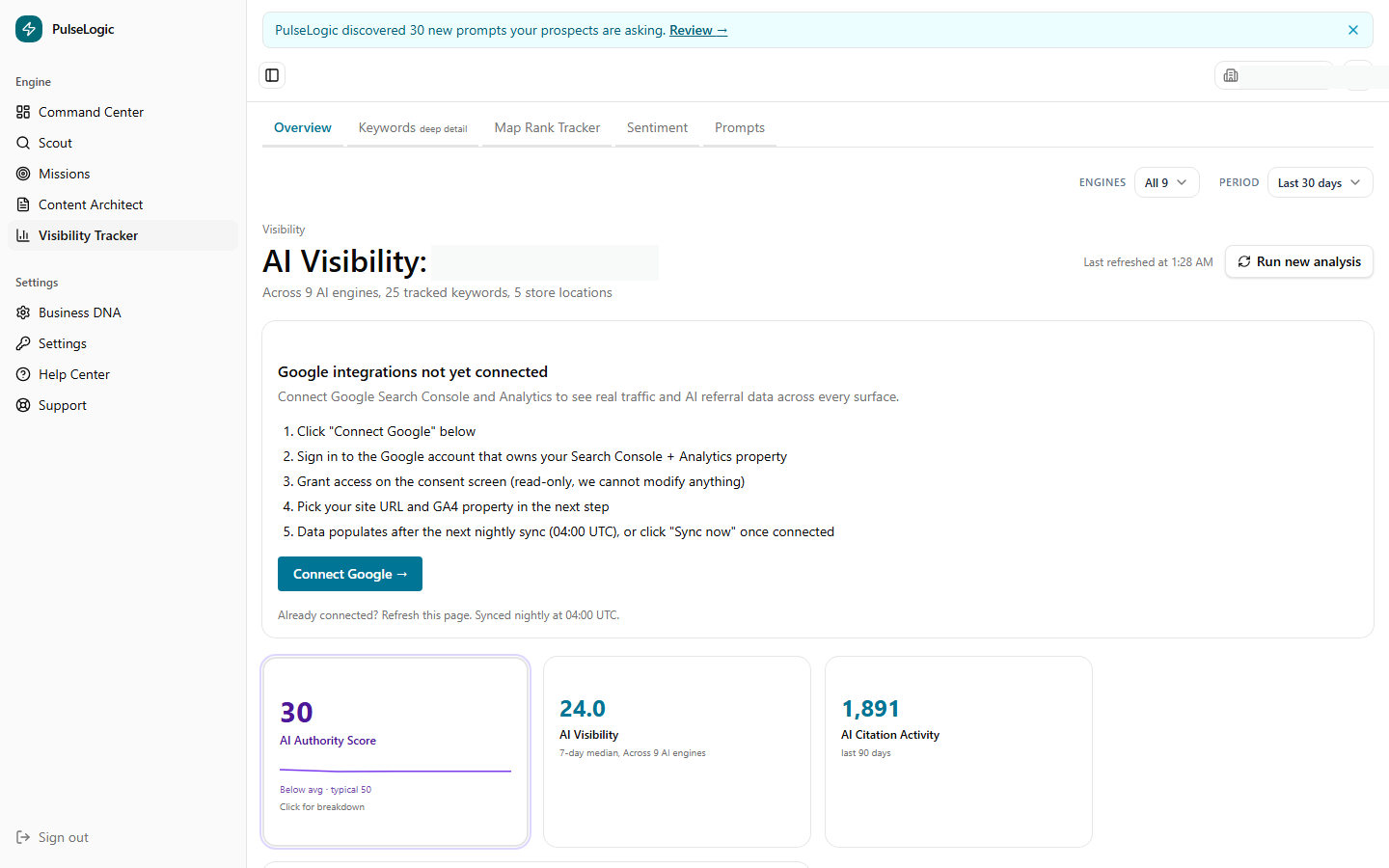
PulseLogic was built to close that loop. It tracks whether you are cited across nine AI and search surfaces, finds the questions where competitors are named and you are not, drafts a clear answer in your voice with real input from your team, validates the structured data that helps engines quote it, and publishes it to your site. Then it watches the score to see whether the answer landed. You do the approving. The platform does the producing and the measuring. That turns GEO from a buzzword into a routine.
Book a walkthrough and we will check whether AI engines name your business for the questions your customers actually ask.
Check my AI visibilityCapabilities reflect PulseLogic as of June 2026. Examples use a demonstration account.