Use case
AI search visibility for local business
When a customer asks an AI engine for the best option near them, does it say your name? For a growing share of searches, that answer now decides who gets the visit.
Picture a shopper in Highland Park typing into ChatGPT: "Where is the best place to buy fresh fish on the North Shore?" Or a parent asking Google's AI for "a grocery store near Northbrook with a good prepared foods section." The engine does not return ten blue links. It returns an answer, naming two or three businesses. If yours is not one of them, you did not lose a ranking. You were never in the conversation.
That is the shift local businesses are living through right now. Search is splitting into two layers. The classic layer, the list of links, still matters and still drives traffic. The new layer, the synthesized AI answer, increasingly decides the search before a single link gets clicked. AI search visibility is whether you show up in that second layer. This page covers how to measure it and how to win it, location by location.
Why local is the hardest and most winnable case
Local is where AI answers get specific. National brands fight over broad terms. A local business lives or dies on "near me" and on a named town. That specificity cuts both ways, which is the good news. AI engines lean on structured, trustworthy, locally relevant content to answer local questions, and most local businesses have published almost none of it. The field is wide open. Show up with clear, well-marked answers to the questions your town is actually asking, and you get named. The competitor who never published stays invisible.
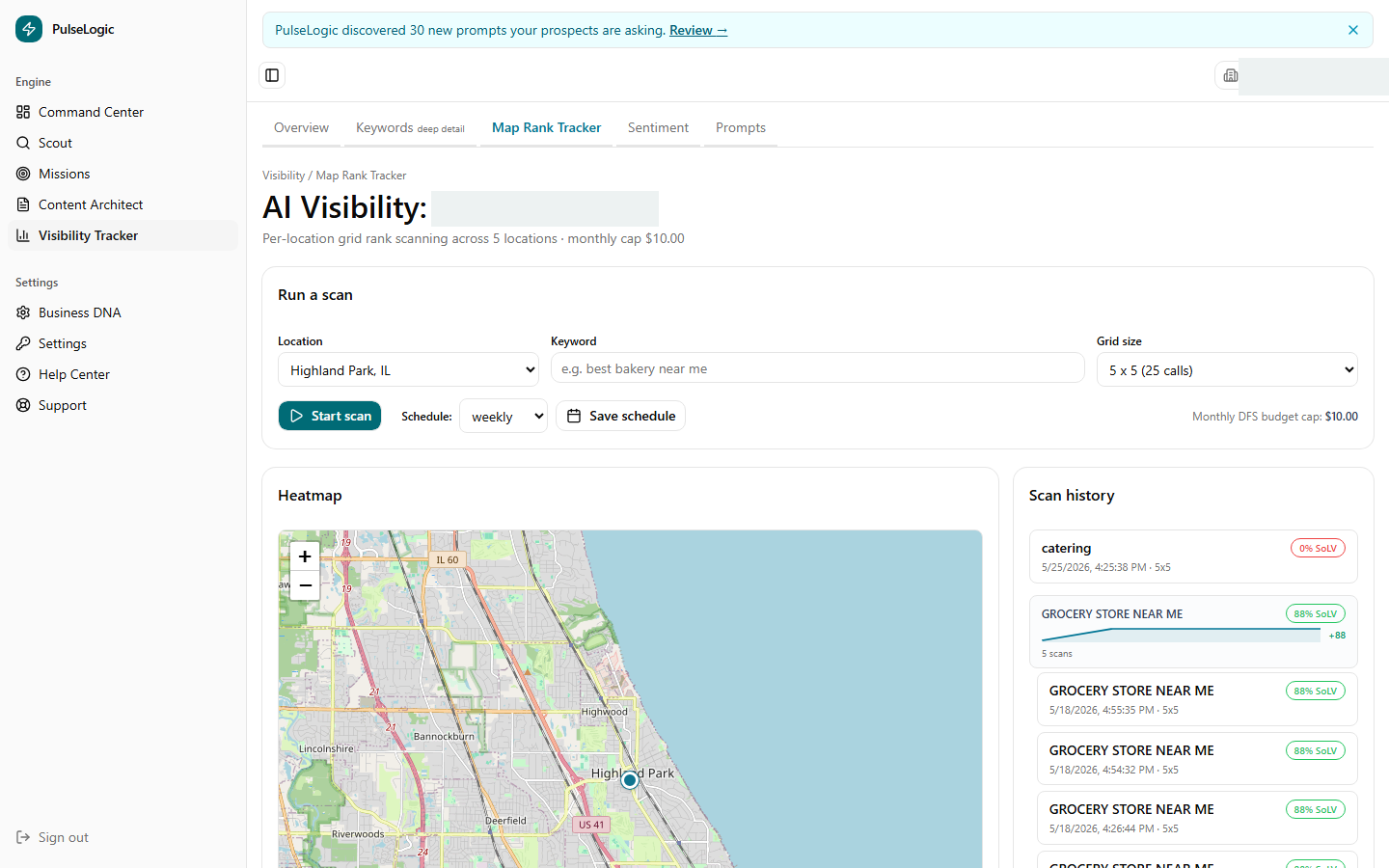
The complication for multi-location businesses is that visibility is not one number. A five-store grocer can be the answer of choice in Highland Park and a ghost in Libertyville. An average hides that. You need to see each market on its own.
The nine surfaces that decide whether you are seen
"AI search" is not one place. PulseLogic tracks visibility across nine AI and search surfaces, because a customer might ask any of them and each one builds its answer differently.
| Surface | What it is |
|---|---|
| Google AI Overview | The AI summary at the top of Google results. |
| Google AI Mode | Google's conversational AI search experience. |
| Local Pack | The map and three-business block for local queries. |
| Featured Snippet | The boxed direct answer above the links. |
| People Also Ask | The expanding related-question results. |
| ChatGPT Search | Answers from the most-used AI assistant. |
| Gemini | Google's standalone AI assistant. |
| Claude | Anthropic's assistant, common in considered research. |
| Perplexity | The answer engine built around citations. |
PulseLogic samples these on a regular cadence and records, for each query you care about, whether you were named, where, and how prominently. That sampling is the foundation of everything else, because you cannot improve what you cannot see.
One score you can actually act on
Raw "you appeared 4 times out of 30" data is a start, but it does not tell you whether you are doing well. PulseLogic rolls visibility into an AIV score from 0 to 100, weighted by how prominent each citation was. Getting named inside a rendered answer counts for more than a passing mention. Being the top-cited source counts for more than being fourth. And the score is benchmarked against businesses like yours, so a local retailer is measured against local retailers, not against a national chain with a thousand-page site. A plain verdict, "above average for local retail" or "ground to make up," means something concrete you can take to a team meeting.
The point of a score is not the number. It is that the number moves when you publish the right thing, so you finally know whether the work is working.
From invisible to cited, the same week
Tracking is table stakes. A dedicated AI-visibility tracker will show you the same kind of chart. What sets PulseLogic apart is what happens after the chart. When the platform finds a query where competitors are cited and you are not, it does not just flag it. It turns that gap into a writing mission, drafts the answer in your brand voice with real input from your team, marks it up with the structured data that helps AI engines quote it cleanly, and publishes it to your site. The loop closes inside one platform: see the gap, write the answer, ship it, watch the score respond.
For a multi-location business, that loop runs per market. If Libertyville is weak on "organic produce near me," the fix is a Libertyville-specific answer, not a generic corporate post. The platform keeps the markets separate so the work stays targeted.
What this looks like for a real business
Take a five-store North Shore grocer we use as a worked example. It competes with national and regional grocery brands. When a shopper asks an AI engine about the best place for prepared foods or the freshest seafood counter, those larger names have a head start. But the local grocer has something they do not: a fish manager named Luis who actually knows the answer. Capture Luis's real knowledge, publish it as the clear answer to the question shoppers are asking, mark it up properly, and the AI engines suddenly have a concrete, trustworthy, local source to cite. That is how a five-store grocer earns a place in an answer next to a national chain. Not by outspending them. By out-answering them.
Book a walkthrough and we will run the nine-surface visibility check on your real locations and show you the first markets and queries worth fixing.
Check my AI visibilityCapabilities reflect PulseLogic as of June 2026. This example is a demonstration account used to show how the platform works.