AI visibility for restaurants
Word of mouth did not die. It moved into the AI answer.
The recommendation that used to come from a friend now comes from an assistant, and diners trust the names it gives back. Ask where six people should eat before the game on Friday and the answer is two or three restaurants, picked from what has been written down about menus, rooms, noise, and hours. AI visibility for restaurants is whether your name is in that answer, for every occasion a diner can describe and every location you run.
Buyer asks
Answer names
The AI engine compares local options, checks the evidence it can cite, and names your business when your content gives it the clearest answer.
Why this market needs answer visibility
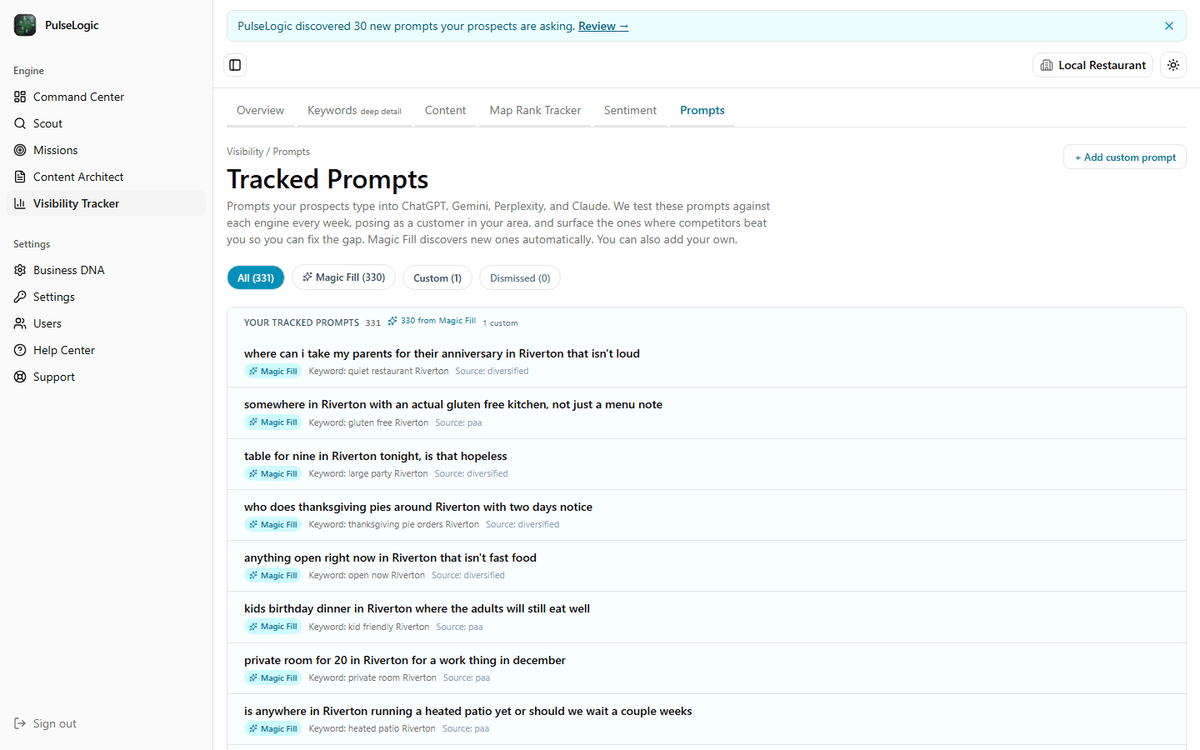
Nobody asks an assistant for a restaurant by name. They describe an occasion and take the names it gives back.
Not better. Just written down.
Your competitors are not winning these answers because their food is better. An AI cannot recommend what nobody wrote down. The place it named instead of you is not better than you. It wrote things down: the private room capacity, whether the patio is heated, what happens with a gluten allergy on a Saturday night, how early the kitchen closes on Sundays. Every one of those is a question a diner asks and an assistant answers, and every one of them lives on somebody's website or nowhere at all. It is also how a single independent competes with the national chains inside these answers, not by outspending them, which it cannot, but by out-answering them, because the answer is built from what got written down rather than from what got advertised.
Occasions, not keywords
Diners do not search for Italian restaurant downtown. They ask for somewhere quiet enough to hear a business conversation, somewhere with a table for nine on short notice, somewhere the kids will eat that the adults will not resent. Those are the questions worth winning, and they are winnable precisely because most restaurants have never answered them anywhere a machine can read. And when an occasion is worth pushing beyond a page, Promote can hand it to Social Tease as a board of ready-to-shoot post ideas, because the same AI answers increasingly read social posts alongside your own site.
Every location scored on its own
A group with four rooms is four different answers. One neighborhood can be invisible while another carries the average, and the average is what most tools report. Each location is measured separately here, so the weak room is a specific thing to fix rather than a suspicion you cannot prove.
What you open to
The morning after you turn it on.
What it does not do
Worth knowing before you buy, not after.
- It does not manage reservations, delivery apps, or your point of sale.
- It does not write menus or reply to reviews.
- It does not guarantee an AI engine will name you. It measures, prioritizes, drafts, and measures again.
Ask an assistant where a group of six should eat in your neighborhood on Friday, then read the names it gives back. The free AI Mirror Test asks that question across all nine surfaces we track today and prints every one of them, so nothing about the result has to be taken on trust.
Run the free AI Mirror TestQuestions
What buyers ask before they start
We are booked most nights. Why would we need this?
Then the honest answer may be that you do not, today. The reason to look now is that the channel is being decided while it is small, and the restaurants being named in these answers are writing the pages that earn it this year. Run the free check and see where you actually stand before spending anything.
Does this help with the delivery apps?
No, and that is deliberate. This is about the diner who asks an assistant where to go and then comes to you directly, which is the cover with no commission attached to it.
We have four locations. How is that priced?
PulseLogic is 249 dollars a month for one address, and each additional location is 49 dollars a month. Every location is scored separately.